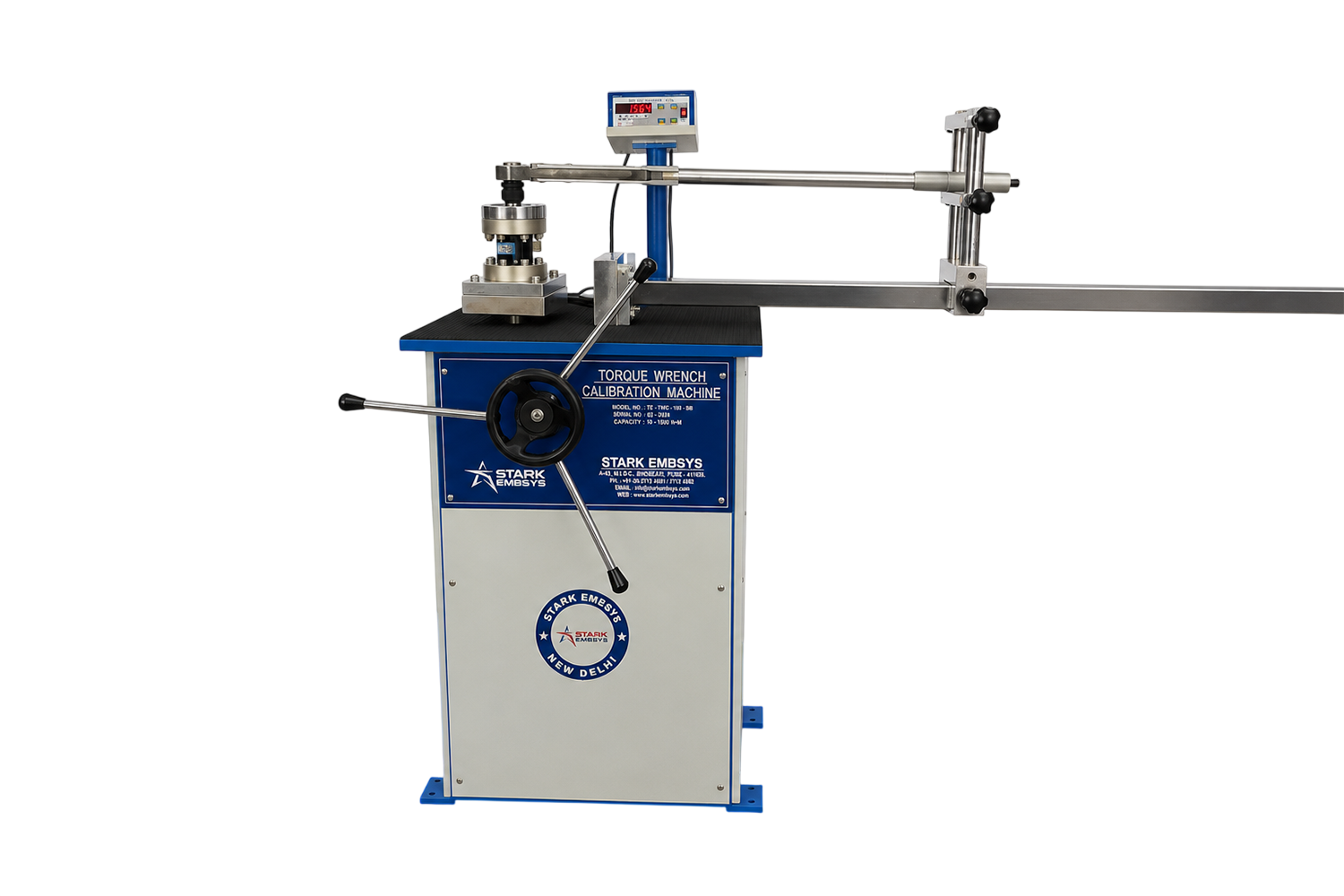
Star Embedded Systems Pvt Ltd is the leading Torque Wrench Calibration Machine Manufacturers, which is an important machine in the industry. The significance and use of this machine is to control tightening of nuts and bolts to prevent over or under stressing. Along with this, the torque is measured so that the product quality and safety is maintained. As the machine design becomes sophisticated, the torqueing of the nuts and screws cannot be compromised so that there is no interference in the working or other issues.
The quality of the machine, its parts are already made of excellent raw material sourced from a trusted vendor. Further, the manufacturing process is optimized for its quality standards.
The expertise of our experienced and trained professionals has helped us produce and supply the best Torque Wrench Calibration Machine. The production process is well monitored to maintain the industrial standards. The loss and repercussions of not fastening a screw could be too much. Thus, a good quality product is ensured from our end.
Searching for a Torque Calibrator? Contact us now!
Anyone who has spent time on an assembly line floor knows the real cost of a mis-torqued fastener isn't the bolt itself - it's the recall, the warranty claim, or worse, the safety failure that follows months later. A torque wrench calibration machine exists purely to stop that chain of events before it starts. It applies a precisely known, repeatable torque through a rotating drive and checks whether your wrench, screwdriver or power tool reports the same value back. If the numbers don't match within tolerance, the tool gets adjusted or pulled from service. Simple in concept, but the accuracy of that reference torque is everything - a calibration machine that's itself off by even half a percent quietly passes faulty tools straight back onto the production line.
A healthy business environment, taking care of all aspects of marketing, production and supplying, Star Embedded Sytems is indeed an expert in Torque Wrench Calibration Machine Manufacturers. Check product details:
• Digital, Dial & Click type Mechanism torque wrench, Electric & Pneumatic Screw driver
• Speed controlled Motorized operation
• PLC & HMI based Fully Automatic
• Computerized report generation software
Low-volume tool rooms calibrating a handful of wrenches a week generally do fine with a manual, hand-wheel operated machine - it's affordable, and an operator applying torque by hand doesn't add meaningful error to the reading. Once you're calibrating dozens of tools a shift, though, operator fatigue starts affecting consistency, which is where the speed-controlled motorized option earns its keep. Facilities running high-volume torque tool certification, or those under an ISO/IATF audit schedule that demands full traceability, tend to move to the PLC and HMI based fully automatic version, since it applies torque at a controlled rate every single time and logs the result without operator input at all.
The heart of the machine is the drive that applies torque to the tool under test, and this is where cheaper machines cut corners. A worn or loose drive coupling introduces backlash - a small amount of "play" before torque actually starts transmitting - which throws off readings on click-type wrenches especially, since they rely on a clean, immediate application of force. We machine our drive assemblies to tight tolerances and use hardened adaptors precisely because this is the one part of the machine that sees the most mechanical wear over its working life.
An ISO 9001 or IATF 16949 auditor isn't going to take your word that a wrench is "calibrated" - they'll want to see the chain of traceability back to a national standard. That means the torque sensor inside your calibration machine needs its own NABL or NPL certificate, renewed annually, with the certificate number cross-referenced on every tool calibration record you issue. We supply this chain from the start - the machine, the sensor calibration, and the documentation format your auditor will expect to see - rather than leaving customers to work it out after the machine's already installed.
Automotive OEMs and tier-1 suppliers run these machines constantly, since torque specs on engine, chassis and safety-critical fasteners are non-negotiable. Aerospace component makers use them for much the same reason, often with tighter tolerance requirements. Tool manufacturers and rental companies calibrate wrenches before they ever leave the warehouse. Many of these same facilities also run a torque tester for quick daily spot-checks between full calibration cycles, or a rotary torque sensor for continuous in-process monitoring on the line itself - all three instruments tend to live in the same QC department.
Beyond the annual sensor calibration, the drive mechanism, adaptors and any motorized components need periodic mechanical servicing - lubrication of the drive train, inspection of the adaptor set for wear, and a check on the display electronics for drift. We stock spares for the drive coupling and sensor assembly so a worn part doesn't take your only calibration machine out of service for an extended stretch, which matters a lot if it's the single point of truth for every torque tool in your plant.
What's the difference between this and a torque tester? A torque tester is generally a simpler bench unit for quick checks; a calibration machine is built to the accuracy and documentation standard needed to formally certify a tool, with a controlled, repeatable torque application method.
Can it calibrate pneumatic and electric screwdrivers too? Yes, with the right adaptor set - just let us know the full range of tool types your plant uses so we can spec the adaptors correctly at the time of order.
How often does the machine itself need recalibration? Annually is standard practice for most audit schemes, though heavy multi-shift use may call for a six-month interval instead.
| Display Type |
Digital
|
| Capacity |
500 Nm to 5000 Nm
|
| Accessories |
Adopters 1/8" to 3/4" (5 Numbers)
|
| Torque applying |
Through hand operated rotating wheel
|
| Warranty |
12 months (from the date of installation)
|
| Calibration |
NPL / NABL Calibrated (Optional)
|
| Torque Sensors |
3 Numbers
|
| Least Count |
0.001 / 0.01 / 0.1 for Nm
|
| Measuring Units |
Nm, Kgm, Lbft / NCm, KgCm, LbInch selectable
|
| Accuracy |
+ 0.5% of the reading
|
| Display |
Micro controller based 6 Digit Digital Display System
|
| Power required |
180VAC to 260VAC @ 50 Hertz
|