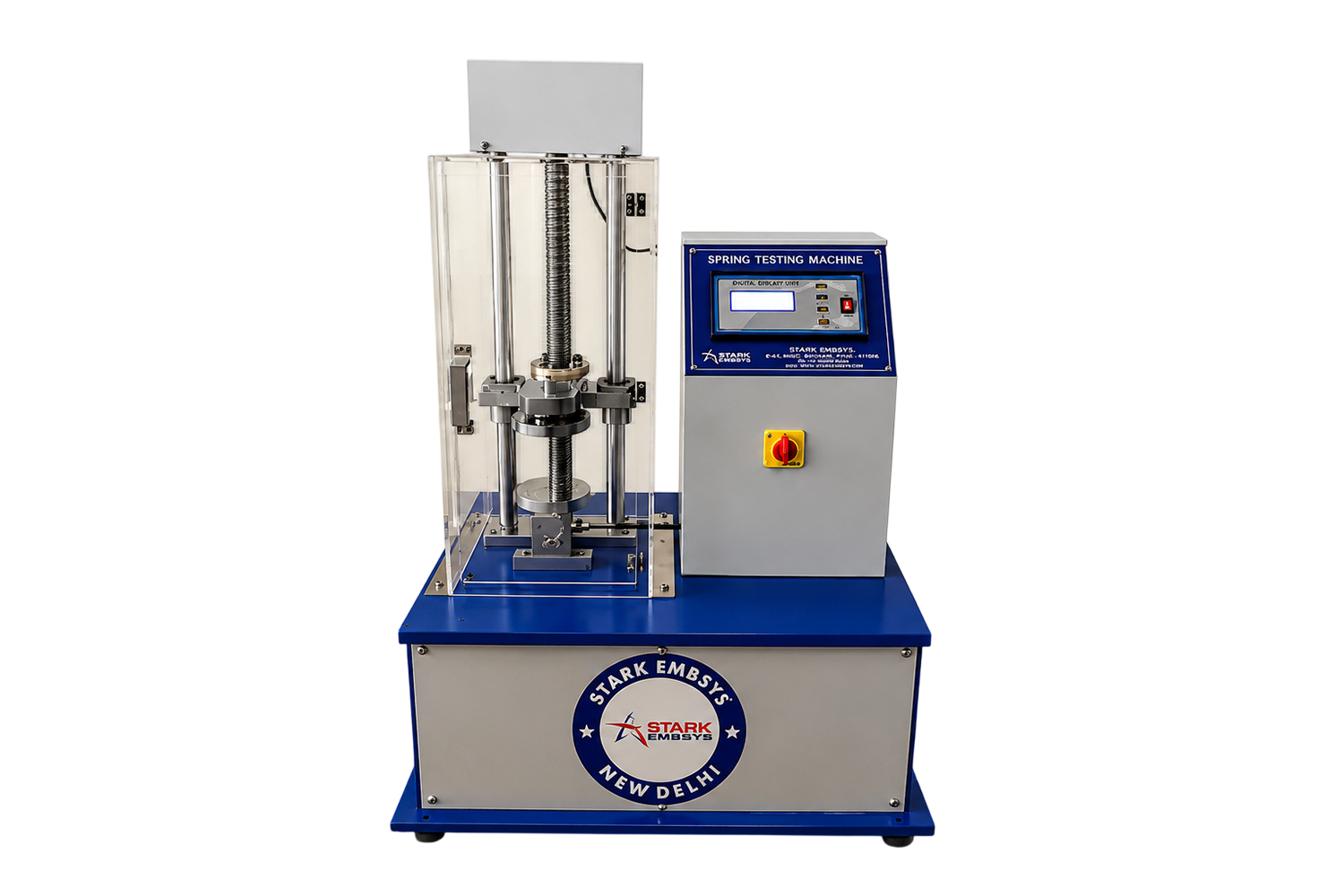
Product Description
Frame
Servo-Hydraulic Universal Testing Machines are manufactured 600, 1000 and
2000 kN capacities. The double acting servo
actuator, which is integrated on the upper crosshead, has a long piston
stroke which makes vertical testing space
accessible for easy and efficient testing of different samples lengths. Load
cell for measuring the load is mounted
between lower grip and base plate.
MULTIFUNCTIONAL REMOTE CONTROL HAND SET
Multifunctional Remote Control Hand Set designed for more practical process
than Electronic Control Unit and PC. Piston
can be moved up-down, can be adjusted test speed, can be adjusted position
of grips and the jaws can be open/close by
Multifunctional Remote Control Hand Set. Able to stop at maximum upper and
lower position and automatically suspend when
can be reached to maximum deformation of capacity should been with Remote
Control Head Set.
Automatic Extensometers
UTM-0540 Automatic Extensometer, 10-300 mm gauge length, 0,1 μm accuracy.
These kind of extensometers are fully
automatic computer-controlled and used for flat and round specimens with
different measurement distance. By means of
high sensitivity it can even used on very delicate materials.
How a Spring Testing Machine Actually Works
Strip away the jargon and the working principle is fairly simple. The
spring sits between a fixed platform and a moving crosshead that either
pushes down on it (for compression testing) or pulls it apart (for
tension testing). As the crosshead moves, a precision load cell mounted
in the line reads the force being applied at every point of travel,
while a linear encoder tracks the exact deflection. Plot those two
numbers against each other and you get the load-deflection curve, which
is really the whole point of the test. A stiff spring will show a steep
curve; a soft one will show a gentle slope. Any kink, dip or sudden drop
in that curve usually points to a manufacturing flaw - uneven coiling,
a bad heat treatment batch, or wire that wasn't drawn to spec.
Compression, Tension and Torsion - Not the Same Test
A lot of first-time buyers assume one machine tests every kind of
spring the same way, and that's not quite right. Compression springs
get squeezed between two flat plates. Tension (extension) springs need
hooks or grips that pull from both ends without slipping, which is
harder to get right than it sounds - a grip that even slightly
misaligns the spring axis will throw off your readings. Torsion springs
are tested differently again, with rotational fixtures that twist the
spring around its axis rather than stretching or squeezing it. When
you're speccing out a machine, it's worth confirming which fixtures are
included as standard and which are optional extras, because that
changes the real cost of ownership quite a bit.
Picking the Right Capacity for Your Springs
Buyers often ask for "the biggest capacity machine" assuming that's the
safest choice, but bigger isn't automatically better. A 10-ton frame
testing a light 2 kg door-hinge spring will struggle to give you fine
resolution at the low end, because the load cell's working range is
tuned for heavier forces. The better approach is to look at the full
range of springs your line actually produces - from the lightest to
the heaviest - and choose a machine (or a dual load cell setup) that
comfortably covers that spread. We usually ask customers a few
questions about their product mix before recommending a
capacity, rather than just selling the top-end model.
Digital Displays vs Manual Dial Testers
Older workshops still run manual dial-gauge spring testers, and there's
nothing wrong with that for basic sampling checks. But once your output
volumes go up, or your customers start asking for traceable test
reports, a computerised system earns its price back quickly. Digital
machines log every test automatically, store the load-deflection graph,
and let you export a signed report without anyone manually copying
numbers off a dial into a register - which, let's be honest, is where
most transcription errors happen. It also makes audits a lot less
stressful when the data is already sitting in the system.
Where These Machines Get Used
Spring testers show up in more places than people expect. Automotive
component suppliers use them for suspension and clutch springs. Two
wheeler and appliance manufacturers test seat springs, kickstand
springs and switch springs. Medical device makers rely on them for tiny,
high-precision springs inside surgical tools and drug delivery devices,
where a soft spring could mean a device fails to actuate properly.
Fastener and hardware exporters run them for third-party inspection
before shipment. In most of these facilities, the spring tester sits
right next to a torque wrench calibration machine
on the same QC floor, since both are checking whether a small mechanical
component is going to hold up in the field.
Keeping the Machine Accurate Over Time
A spring tester is only as good as its last calibration. Load cells
drift slightly with heavy daily use, and the crosshead's linear
movement can develop small mechanical play if the guide rails aren't
greased on schedule. We recommend a calibration check at least once a
year, more often if the machine runs multiple shifts, and we can arrange
NABL-traceable calibration certificates on request. If your facility
also runs a rotary torque sensor
or standalone torque sensor setup,
it usually makes sense to schedule all your force and torque instruments
for calibration in the same visit - it saves on service call charges and
keeps your entire measurement chain consistent.
Choose Spring Testing Machine Manufacturers for all the right
reasons
Rely on the Spring Testing machine by Star Embedded Systems for accuracy and
quick results -the best for load deflection
tests of tension and compression springs. The most reliable and affordable
quality assured equipment to satisfy the
customer demand.
The recent developments in technology and features are analysed for
incorporation into our existing process of
production by research and marketing team. This is then checked for
feasibility. After thorough analysis, the features
are then integrated if found feasible and suitable for the manufacturing
process and satisfies overall aspects. Our
researchers are more keen on constantly conduct varied researches and
surveys to bring new innovations in the offered
products and manufacturing techniques.
For best price, contact the best Spring Testing Machine
Manufacturers- Star Embedded Systems Pvt Ltd.
A Few Questions We Get Asked Often
Can one machine test both compression and tension springs? Yes,
most of our frames are built to handle both with a change of fixture -
you don't need two separate machines unless your volumes justify a
dedicated line for each.
How fast can the crosshead travel? Speed is adjustable, typically
from 0.0005 mm/min for slow, precise testing up to several thousand
mm/min for quick production-line sampling, depending on the model.
Do you supply the fixtures for odd-shaped springs? We build
custom grips and hooks for non-standard spring geometry - just send us
a drawing or a sample and we'll work out a fixture that holds it
securely without damaging the coil ends.
What about after-sales support? Our engineers handle installation,
operator training and annual servicing, and spares for the load cell and
drive assembly are kept in stock so a breakdown doesn't halt your
production line for weeks.